
7. Givenness
The internet · the failure of liberalism · stories and the moral imagination

I’ve seen Samuel James’s Digital Liturgies (2023) getting a lot of praise recently and, having finished the book, I think it’s well deserved. The author’s burden is to help the reader to rediscover Christian wisdom in an online age in which digital technology is training us to think of ourselves and the world in disembodied ways and instilling in us the sense that our identity is something we create, rather than something we are given. To be clear, the point is not so much that the internet’s content preaches “expressive individualism” to us (though that is certainly true) as that the internet itself, as a medium, inherently serves the placing of the self at the centre of all things. Far from being a neutral tool, the internet has become a teacher of our souls. Outlining five “digital liturgies,” James explores the ways in which the internet, as a spiritual and intellectual habitat, profoundly shapes our habits of thinking, feeling, and believing. This is a much-needed book for everyone who spends time online without having thought critically about how that might be forming the mind and soul.
The subject of givenness is also treated in Patrick Deneen’s diagnosis of the political ideology we call liberalism in his book, Why Liberalism Failed (2019). Deneen’s basic thesis is that liberalism has failed, not because it fell short but precisely because it succeeded. As liberalism has become more fully itself, its inner logic and self-contradictions have generated inequality, enforced uniformity and homogeneity, fostered material and spiritual degradation, and undermined freedom—and these are a feature, not a bug. Deneen describes liberalism as an anticulture that uproots three cornerstones of human experience and culture: nature, time and place. It “destroys actual cultures rooted in experience, history, and place.” Here he’s talking about the givenness of life. We don’t choose the life and the community we’re born into; they are given to us without our say. Liberalism, however, ignores this givenness and the rootedness of human beings in local communities. So argues Deneen. This was a good read, and I look forward to following it up with Deneen’s latest, Regime Change (2023).
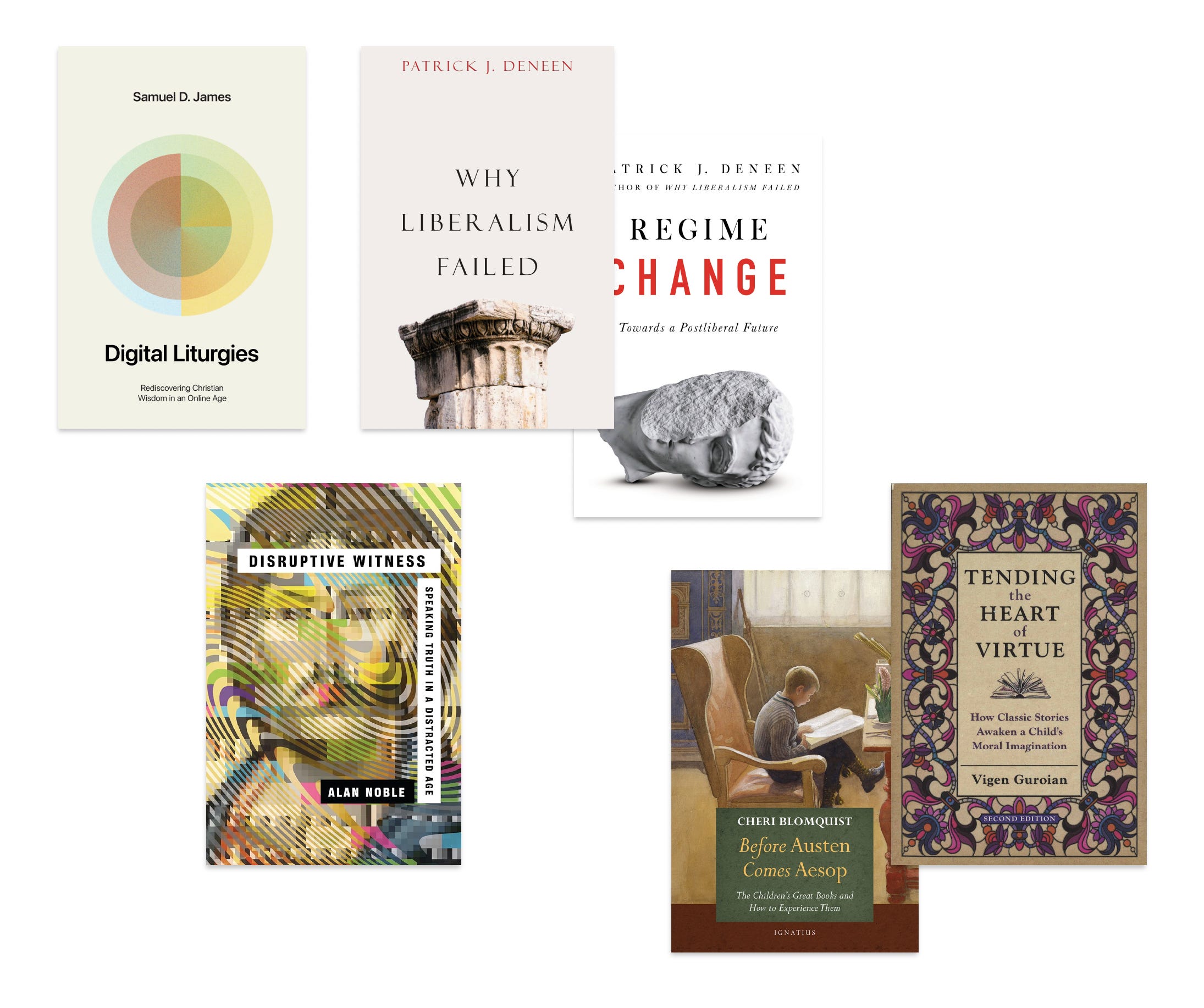
Alan Noble’s Disruptive Witness (2018) was a thought-provoking examination of the challenges of speaking Christian truth in what Charles Taylor calls a “secular age.” Drawing heavily from Taylor’s work, Noble discusses why it’s so difficult today to talk to people about the gospel in a way that actually pierces through and disrupts the wall of constant distraction that shields them from deep, honest reflection about thick, spiritual matters. Though in my opinion the book’s prescriptive parts leave something to be desired, its strength is its insightful description of the challenge we presently face in our witness as Christians.
I want to close by highlighting one book I’m currently reading and enjoying: Tending the Heart of Virtue (2nd ed., 2023) by Vigen Guroian. Originally published in 1998, this is a book about the power of classic children’s tales and stories to form the moral imagination. Stories are able to present a compelling vision of “the goodness of goodness itself” in a way that both addresses the mind and stirs the imagination and affections. Guroian demonstrates how various stories—such as Cinderella and The Wind in the Willows (which, by the way, was marvellous!)—serve as a medium for this kind of moral education. This book has been giving me what I was looking for, but did not find to satisfaction, in Blomquist’s Before Austen Comes Aesop (2021). I’m convinced that it’s vital to engage children not simply with didactic instruction but also with good stories that bring moral principles to life in the imagination. As the author Flannery O’Connor put it, “a story is a way to say something that can’t be said any other way. You tell a story because a statement would be inadequate.”
Up next in December is a list of my top books from last year, followed by one for 2023. I’d be interested to hear: What were some of the best books you read this year?